
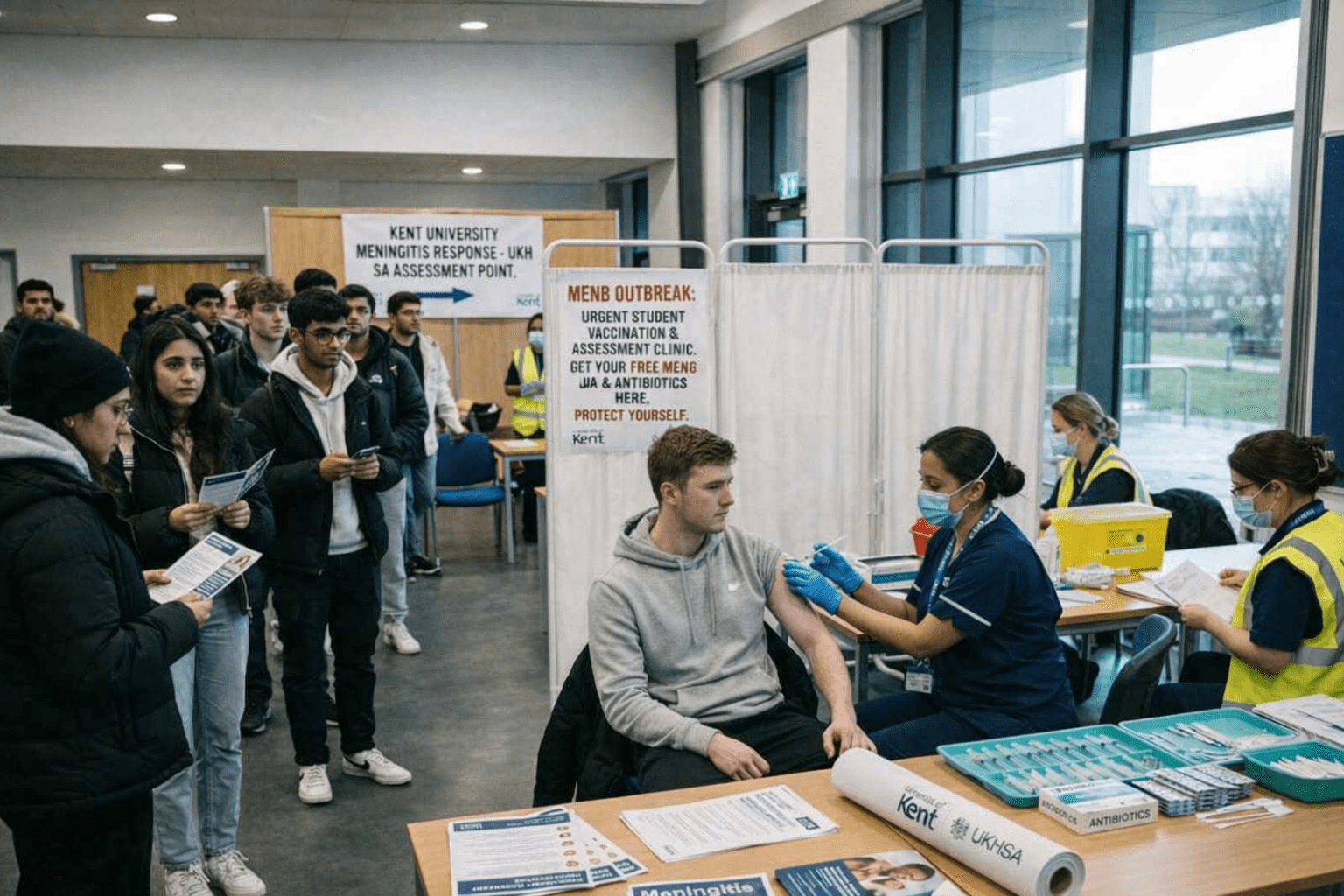
The meningitis outbreak at the University of Kent has revealed long‑standing weaknesses in how student health risks are managed across the United Kingdom. Gaps in vaccination coverage, delays in reporting and unequal access to prevention combined to create a crisis that was predictable and preventable.
A Crisis That Exposed the System
It began as a routine health alert. Within days, it turned fatal.
In March 2026, a cluster of invasive meningococcal disease at the University of Kent escalated rapidly. The university cancelled in‑person exams, and a large public health response was launched. Two deaths, including a university student and a local sixth‑form student, have now been linked to the outbreak.
More than thirteen thousand doses of antibiotics were distributed. Over ten thousand vaccinations were administered in a matter of days.
The response was swift. The vulnerability was not.
What unfolded in Kent was not an isolated event. It exposed weaknesses that have existed for years within the United Kingdom’s higher education and public health systems.
A Known Gap in Protection
The MenB vaccine was introduced into the infant immunisation schedule in 2015. Although this was an important step forward, it did not include a full catch‑up programme for older children.
This created a cohort of students, particularly those born between 2003 and 2007, who entered university without protection against meningococcal B.
They received the MenACWY vaccineas teenagers. It does not protect against MenB.
Professor Paul Hunter, an infectious disease expert at the University of East Anglia, has repeatedly warned that partial vaccine coverage creates conditions where outbreaks can emerge in specific populations.
University environments amplify that risk. Large numbers of students live in shared accommodation, interact closely and move through dense social networks. These are ideal conditions for rapid transmission.
The risk did not begin in Kent. It accumulated over time.
Dr Simon Clarke, associate professor in cellular microbiology at the University of Reading, notes that outbreaks in such environments are not random events. They are predictable outcomes of how these systems are structured.
High‑Density Living and Superspreader Conditions
A UK Health Security Agency technical briefing indicates that a significant proportion of confirmed cases linked back to a high‑contact social setting in Canterbury between the 5th and 7th of March.
Although final epidemiological confirmation is ongoing, early findings suggest that up to 87% of cases were associated with this event.
This aligns with known transmission patterns. Meningococcal bacteria spread through close and prolonged contact. Student accommodation, lecture halls and nightlife venues create ideal conditions for this.
Universities are built for connection. That is their strength. It is also their vulnerability.
The Cost of Prevention
Access to protection remains uneven.
The MenACWY vaccine is provided free through the NHS. The MenB vaccine is not routinely available to this age group. Students who want protection often have to pay privately, with costs reaching approximately 220 pounds.
This creates a financial barrier to prevention.
Dr Rak Nandwani, a public health consultant, has highlighted that relying on individuals to fund their own protection introduces inequality into what should be a coordinated public health strategy.
In shared living environments, those gaps do not remain individual. They become collective risk.
Delays in Reporting and System Pressure
The outbreak has also raised concerns about the timing of initial reporting.
A BMJ report indicates that the first suspected case was not escalated to the UK Health Security Agency for approximately twenty-six hours. Experts, including Professor Hunter, have described such delays as indefensible given the speed at which meningococcal disease progresses.
Early detection and rapid reporting are essential in preventing spread. Delays reduce the window for intervention.
Although the emergency response in Kent was robust, this phase exposed weaknesses in the early warning process.
A System Under Strain
The pressures extend beyond public health agencies.
The Office for Students has reported that nearly half of higher education providers in the United Kingdom are facing financial deficits in the 2025 to 2026 period. This affects student health services, which are often under‑resourced.
At the same time, wider healthcare access remains a concern. Healthwatch England data shows that many people lack confidence in accessing timely care through GP services, accident and emergency departments and hospitals.
Universities operate within this wider system. They house risk but do not fully control the mechanisms needed to manage it.
Responsibility is shared. Accountability is less clear.
Beyond Kent
The University of Kent outbreak is not an anomaly. It is a case study.
It shows what happens when partial vaccine coverage, high‑density living, financial barriers and delayed reporting intersect.
Each of these factors is known. None are unique to a single institution.
Together, they create a system that responds quickly in crisis but remains underprepared for prevention.
A Way Forward
Two lives have already been lost.
The conditions behind this outbreak were not unexpected. The vulnerabilities were already visible.
What Kent has provided is clarity.
The next outbreak will not be a surprise. It will be evidence that the system understood the risk and failed to act on it.
Pull‑Quotes
“The response was swift. The vulnerability was not.”
“Universities are built for connection. That is their strength. It is also their vulnerability.”
“In shared living environments, individual gaps become collective risk.”
“The next outbreak will not be a surprise.”
Credit:
This article is featured in partnership with Amberstudent, a global student housing platform that helps students find and book verified accommodation near leading universities in more than two hundred and fifty cities worldwide.
Learn more at https://amberstudent.com